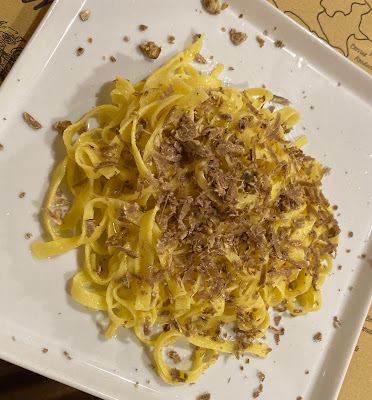
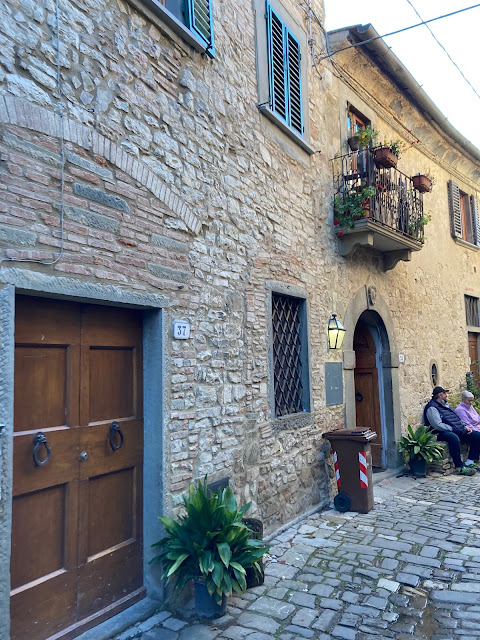
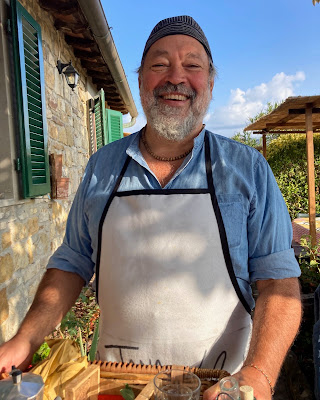
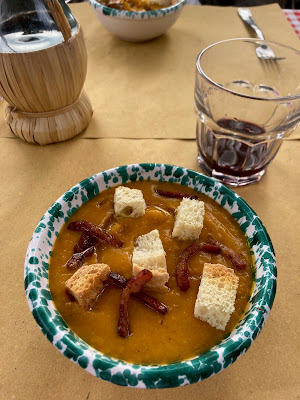
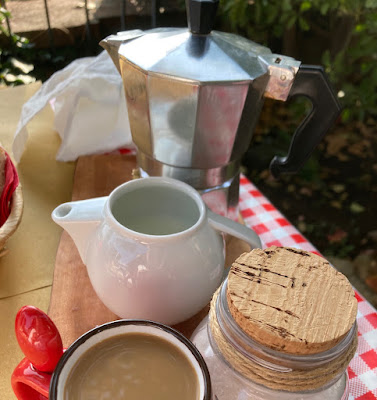
Scrumptious was the word. Roberto also threw in a bottle of house wine, a deletable white at only €15 and a complimentary plate of polenta in cheese sauce once again topped by shavings of local white truffle, all served by his wife.
Friday, December 30, 2022
A Farewell to 2022 in Florence & Tuscany, Part II
Scrumptious was the word. Roberto also threw in a bottle of house wine, a deletable white at only €15 and a complimentary plate of polenta in cheese sauce once again topped by shavings of local white truffle, all served by his wife.
Thursday, December 29, 2022
A Farewell to 2022 in Florence & Tuscany, Part 1
After the Tuscan population was steamrolled by Omicron in early January, my friend Deborah and I, wearing masks as was everyone, made our annual getaway to the Tuscan ski resort Abetone. Brilliantly cold and clear, the setting was the one we found below.
The trail through the woods is a ski run. Alas, this December, this image is a mirage. Probably due to climate change, the temperatures are above freezing, there has been torrential rainfall. No snow at a ski resort. We're still hoping things will change by February at least...
The same month brought the annual International Holocaust Day of Remembrance on January 27, 2022. The Uffizi Gallery unveiled a new acquisition, a portrait of young woman with closed eyes entitled "Flame" by genocide victim German Expressionist art Rudolf Levy, who was deported from Florence.
The stumbling stone located outside his hiding place -- a friend's apartment at piazza Santo Spirito no. 9 -- was placed there this year to ensure that posterity will not forget Rudolf Levy and others who suffered the same fate.
The museum is divided into four rooms, each devoted to a protagonist of the WW2 campaign: partisan resistance fighters, Italian fascists, American soldiers and their German counterparts.
Unfortunately, a group of partisan resistance fighters attacked a car with German soldiers in Pianosinatico, killing an officer and an enlisted man on September 27, 1944. The Nazis rounded up 11 men in the village on the same day and shot them in revenge. Nine were over the age of 55 and one of them, Tullio Levi, was a Jew from Parma who thought he had found a safe and remote place to hide.
Friday, December 31, 2021
Looking Back on Tuscany, 2021
Well, this blog is called "Beautiful Florence -- Tuscan Living, from Rosanna's perspective," so as an end of the year post, I will concentrate on memories from this year in Tuscany.
These recollections began in July, as the first half of the year Tuscany was either in the "red" or "orange" zone. Designed to contain COVID contagions, residents were not allowed to travel outside their town or city of residence, except for work, health or emergency reasons. Now, as a journalist with a press pass, I could have faked it, but chose not to. Hence, apart from press conferences in Prato and Montalcino in June, my first trip for pleasure was in July. Robert Shackelford invited me on a Harding school trip to the Casentino.
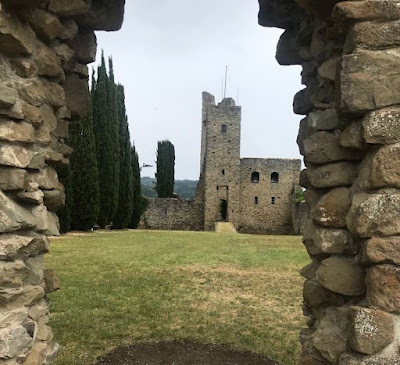
Casentino is an area of wooded hills and mountains, interspersed with a lush valley and scattered hamlets. It is also the source of the Arno River, and is also known for its authentic medieval castles.
The photo above is of Romena Castle, built on its present site in 1152 atop a previous fortification from 1008 A.D. Dante Alighieri was a guest at this castle, which belonged in the Guidi counts, and cites a village in the immediate surroundings in the Divine Comedy's Inferno. Unlike Inferno (or: Hell), it was a cool place on a hot summer's day. The castle can be visited from April 1 to October 31 for the modest price of €3. Obviously the owner, Niccolò Goretti de' Flamini is not interested in exploiting history for $$$ unlike Disney World.
Tuesday, August 11, 2015
The Tuscan Summer of 2015 & 1944
Braccioforte (Strong Arm) who sheltered them. He headed a group of 200 men, the Perseo brigade, who sabotaged the German's mean's of communications and routes, also to help defend the
local population.
Isn't it a beauty?
single rose window.
Indelible memory.
nothing less than a Tuscan big brother.
Thursday, May 8, 2014
A Girl and A Man with a Pearl Earring
currently closed for restoration.
At the press conference, curators told the audience that "99% sure" that the Girl was a figment of Vermeer's imagination. After all, he and his wife had at least a dozen children, and apart
from earning a living as an artist,
perhaps Vermeer needed to go off and paint as a respite from the cares of daily life.
Who knows? Art historians hold, however, that the Girl with a Pearl Earring is an example of the
"tronie" genre diffuse in Holland during this period. A "tronie" is defined as a painted head or bust of an imaginary figure often wearing exotic costume."
The exhibition in Bologna also displays pieces by Vermeer's contemporaries, including Rembrandt, who is represented by another "tronie," a painted head of an imaginary sitter, also wearing an earring.
Notice Rembrandt's masterly use of light and shadow.
Another fact that was revealed to journalists is that pearls during this era were freshwater, and that large pearls were often made of Venetian glass and painted. Whether this was the case with the Girl
and "Woman Writing a Letter," I personally like to believe it was not -- and that the pearl is real.
After all, thanks to Vemeer's timeless poetic realism, one would almost expect the Vermeer's Girl to
step out of the canvas and draw a breath...
Though her rarely left his home in Delft, Vermeer's masterful style, even during his lifetime, proved to be far-reaching, down to Italy, influencing the Florentine Baroque artist
Alessandro Rosi (1627-1707).
How did we find Florence's male counterpart to the Girl with a Pearl Earring?
Sipping an espresso in a café close to the office one day, I perused a local paper and found an article on an acquisition by the renowned, local antique dealer Giovanni Pratesi.
I have known Sig. Pratesi for many years, since he became the head of
Florence's prestigious Antiques Biennale.
I originally met him in 2001 when I wrote about a Michelangelo drawing belonging to a collection in England on display and on sale at the Antiques Biennale for the International Herald Tribune
(now the New York Times International).
. Sig. Pratesi has a propitious, time-honored custom of purchasing a work for New Year's, as recorded below by Beautiful Florence faithful
blog photographer Kori Endo. This year he went to Padua to identify and buy Rosi's
Man with a Pearl Earring.
Yes, it is pearl earring he is wearing, but he is not an imaginary figure.
Thanks to his fancy dress, the young man is believed to be the paramour of
Antonio de' Medici, a married man and father.
Antonio, who lived in the shadow of his own powerful father, was the son of Florence's ruler
Francesco de' Medici and his second wife, Bianca Cappello, but born before their marriage.
Francesco and Bianca came to a bad end at the Medici villa Poggio a Caiano, both poisoned by his son by his first marriage, who succeeded him.
When I asked Sig. Pratesi why he bought the painting, he responded:
"la bellezza era un motivo valido"
(its beauty was reason enough). He told me that a pearl was at that time identified with aristocracy in Florence, hence the Medici connection.
The young man's pearl, however, is as dark as his story--that of a love slave--
The Man with a Pearl Earring, was, and even now, is for sale.
A marked contrast to the idealized and light-filled Girl and her Pearl.
She just is.
Even now, during her Italian sojourn,
she currently attracts 3,000 paying visitors a day--5,000 on Sunday.
reporting on assignment from Beautiful Florence
-- Rosanna
Tuesday, March 19, 2013
Rufina: Finding Old Acquaintances in a Tuscan Villa
were invited guests at an event hosted at Villa il Petroio. Upon arrival, after going up the Tuscan hills near Florence between Rufina and Pontassieve, I recognized host Eduardo Robiglio (left). whom
I had interviewed in Florence seven years ago. He introduced me to his mother, Carole Bolton (right).
I discovered that Carole and I had studied, in different years, at Florence's Università per Stranieri
(University for Foreigners). She told me that right before she was to leave, she met her future husband,
Eduardo's father.
Why did I talk to Eduardo in 2006? I am best known as an art writer, if not art,
then food.
The dessert that was served to the guests at lunch, chocolate truffles, gives the idea of the subject of
our talk, which was hot chocolate. I reported that the premium Italian hot chocolate served at the Robiglio café on via de' Servi "represents a family tradition spanning 75 years."
Just a year later Eduardo sold the business and they started a new chapter in life.
The Robiglio had renovation work done on their weekend home in the Tuscan countryside.
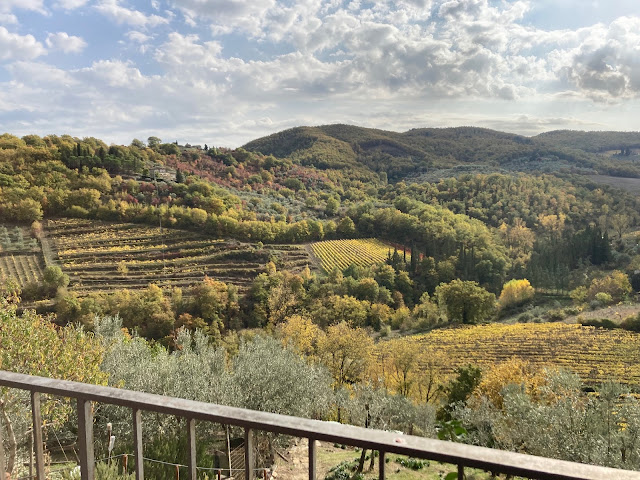
This is the view from Villa Petroio on a variable March day.
The Robiglio family now rents the villa, guest wing and medieval village to host weddings or family reunions as well as producing estate-bottled olive oil and wine.
Speaking of wine, above are bottles of Villa Petroio wine, a blend of Tuscan Sangiovese and Canaiolo grapes with Merlot, on the lunch table. As you can see, the floral arrangements matched the furniture.
Ever curious, I wandered into the kitchen for another surprise.
One of the cooks was a family friend just giving a hand.
"I've known Eduardo since he was a child," said Anna Bini (above).
The surprises continued. Holding up eight fingers to represents decades, she confided her age.
Initially working in fashion in Florence, she moved to Paris to open a restaurant in order to legally employ her three sons. "With a work contract abroad, this meant they were exempt from the draft,"
she told me. "And one of my sons liked Paris so much that he is still there today
to manage the Casa Bini restaurant," she added.
Anna's proud demeanor was a mix between Parisian and Tuscan.
Pointing to the risotto with Tuscan porcini mushrooms that she had prepared,
Anna said in a whisper, "the rice is parboiled."
It was delicious. I explained to Anna that parboiled rice is common in the U.S., which was
after all Carole Robiglio's homeland.
The hospitality continued with a concert of Florentine folk songs.
The group sang traditional stornelli which they heard as children.
The instruments ranged from the accordion, guitar and tamborine to
(surprise again), a saxophone.
The group's name is Gli Amici del Chianti, but talking to them I discovered the musicians hailed from the nearby Valdarno area, only part of which could be loosely defined as "Chianti."
Maybe the fact that Disney has also hired them to entertain Americans on tour in Tuscany
inspired their name.
The accordion player, named Simone, told me that he comes from
a village of 100 residents named
Bombone.
"But I have been there!" I exclaimed. "During my first summer here during the '80s, I was hosted by a family in a remote area called 'Marnia' in the woods near Rignano. One hot August evening, we drove over to Bombone, as we found out, the place were artist Ardengo Soffici was born, to attend
a donut festival. Townswomen wearing comfy slippers were frying and serving
donuts (bombolone) on the streets of Bombone at midnight.
As usual, I was the only American in sight.
"Bombone is near Rignano sull'Arno, the home of Florence's mayor
Matteo Renzi," he said.
"And did you know him?" I asked.
"Of course, I remember him as a child walking down the street with the newspaper under his arm,
a sure sign of his future calling," he replied.
"And now?"
"Well, I voted for him...and he disappeared, a true politician," he told me.
"Let's drink to that," said everyone else within earshot.
Reporting live from Villa il Petroio
for Beautiful Florence.
--- Rosanna