Saturday, October 1, 2011

The Antiques Biennial--A Timeless Event

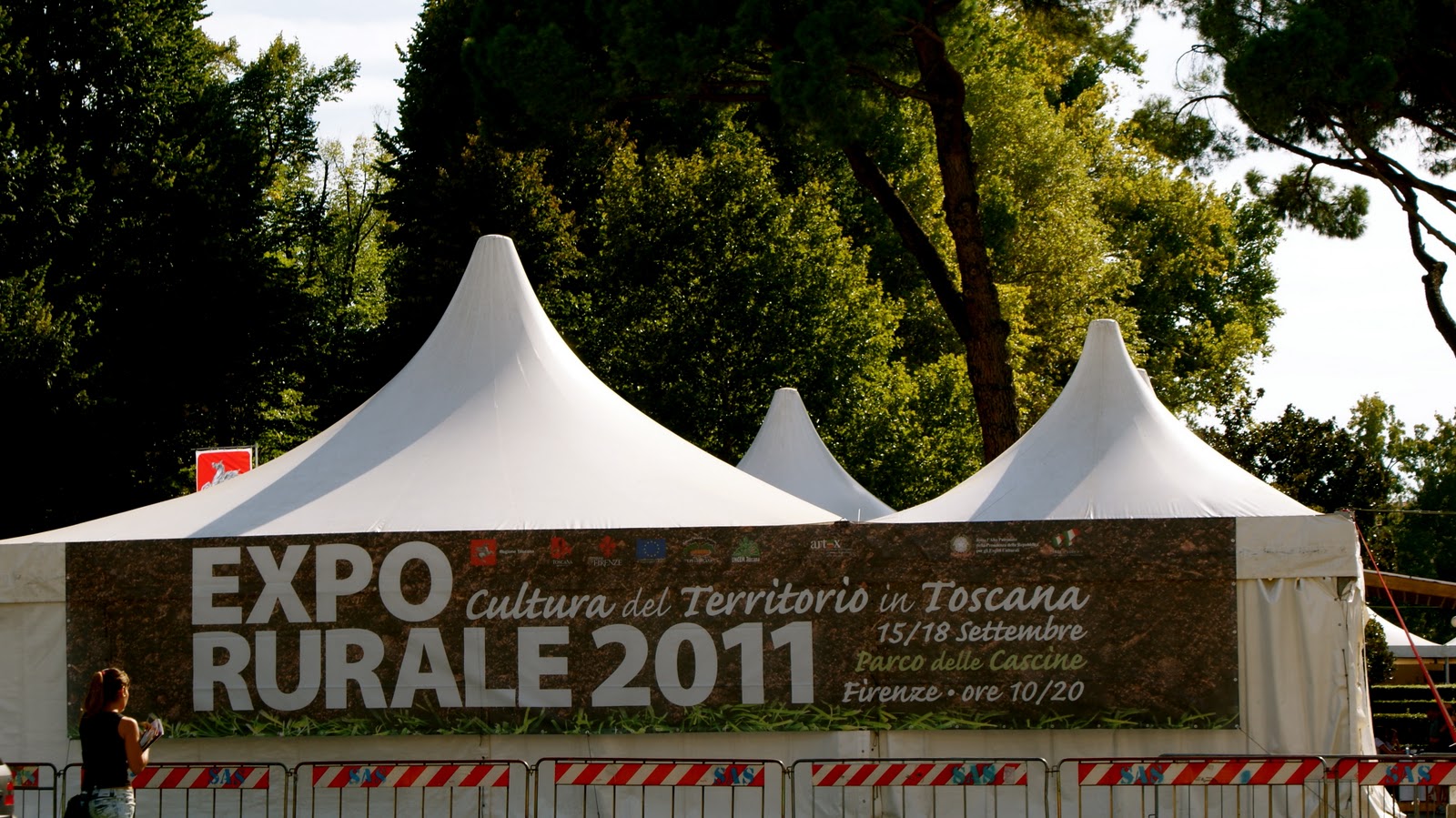
The Italians have a saying, dalle stelle alle stalle, "from the stars to the stalls, roughly equivalent to "Pride comes before a fall." Add this to the common knowledge that journalists (at least the real ones) work too hard but are often compensated with fabulous perks in order to get the idea of photographer Carly's and my experience at the Florence Antiques Biennial, our first outing after the County Fair (Ruralia, see preceding post) in the Cascine Park.

As the name implies, this world-renowned show-- the oldest of its kind in Italy— offers visitors the opportunity to view and perhaps purchase rare works created by prestigious artists that are destined to become part of private and public collections. Our first stop on during this Cinderella day was the press conference, held at the Villa Cora hotel (see July's post "Poolside Cocktail Hour" to get a good look at where we were invited guests).

Not bad, huh? But let's not forget that we were there for work. Besides the Beautiful Florence blog, an article on the Antiques Show was published by my company, Magenta, in Vista, Florence & Tuscany, the area's only magazine in English. We joined our colleagues in the lobby to sign in for the press conference.


Once inside, the Biennial's president, Giovanni Pratesi, told us that Italian antique dealers dominate the show—only 14 of the 88 exhibitors come from foreign countries. On display until October 9 are an astonishing number of artworks--2700 in all--ranging from paintings, sculptures, furniture, porcelain and textiles to represent various time periods and artistic styles. The oldest exhibits date before Christ, with the bulk falling somewhere in the 17th, 18th and 19th centuries. As we were to notice, there was also a scattering of outstanding modern and contemporary works--you could actually take home a MirĂ² if you happen to have enough change in your pocket.

The conversation on the Antiques Biennial continued over a complementary lunch (this is Italy after all).

While Giovanni Pratesi (pictured right) was waiting for the next course to arrive, he confided to journalists that, because of the recession, the antiques market for buyers has never been better thanks to many cash-hungry art patrons who are sacrificing a jewel or two of their collections. He also praised the work of a commission of experts who certified each antique's authenticity, removing any piece of dubious make or origin. Exportation of antiques is also a problem--the best case scenario is a 40-day wait, but in the case of a sale at Florence's Antiques Show, the permit is granted in only two days! Carly and I were the only foreign press members present--our Italian colleagues did not bat an eyelash. In Italy, it is all a matter of who you know... After lunch, the hotel provided shuttle service to the Antiques Biennial venue, Palazzo Corsini.


Again, not bad, huh? Palazzo Corsini is located in downtown Florence (riverside address: Lungarno Corsini). The Corsini family rent it out to the Antiques Show every two years. Each section of the Biennial is planned by set designer Pier Luigi Pizzi to complement the existing frescoes and baroque decorations characteristic of Palazzo Corsini.


After showing my press pass (they even checked the photo), Carly and I spent nearly two hours on the ground floor where we visited the 40 stands located there. At stand #1, Robilant, we immediately noticed a beautiful antique painting, "A View of the Arno and Ponte Santa Trinita in Florence" by local expatriate artist Thomas Patch (Exeter 1725 - Florence 1782).

At Carlo Orsi's stand, there was an original plaster cast for a statue depicting Cupid (or: Amorino) by no other than the Neoclassical sculptor Antonio Canova.


Moving on, we arrived at a stand (to remain nameless) right at the moment when an antique dealer opened a secret door to show some hidden treasure (we think) to a prospective client.


When we asked the dealer what was it was, he closed the door and told us to come back in a half hour. Mum's the word.

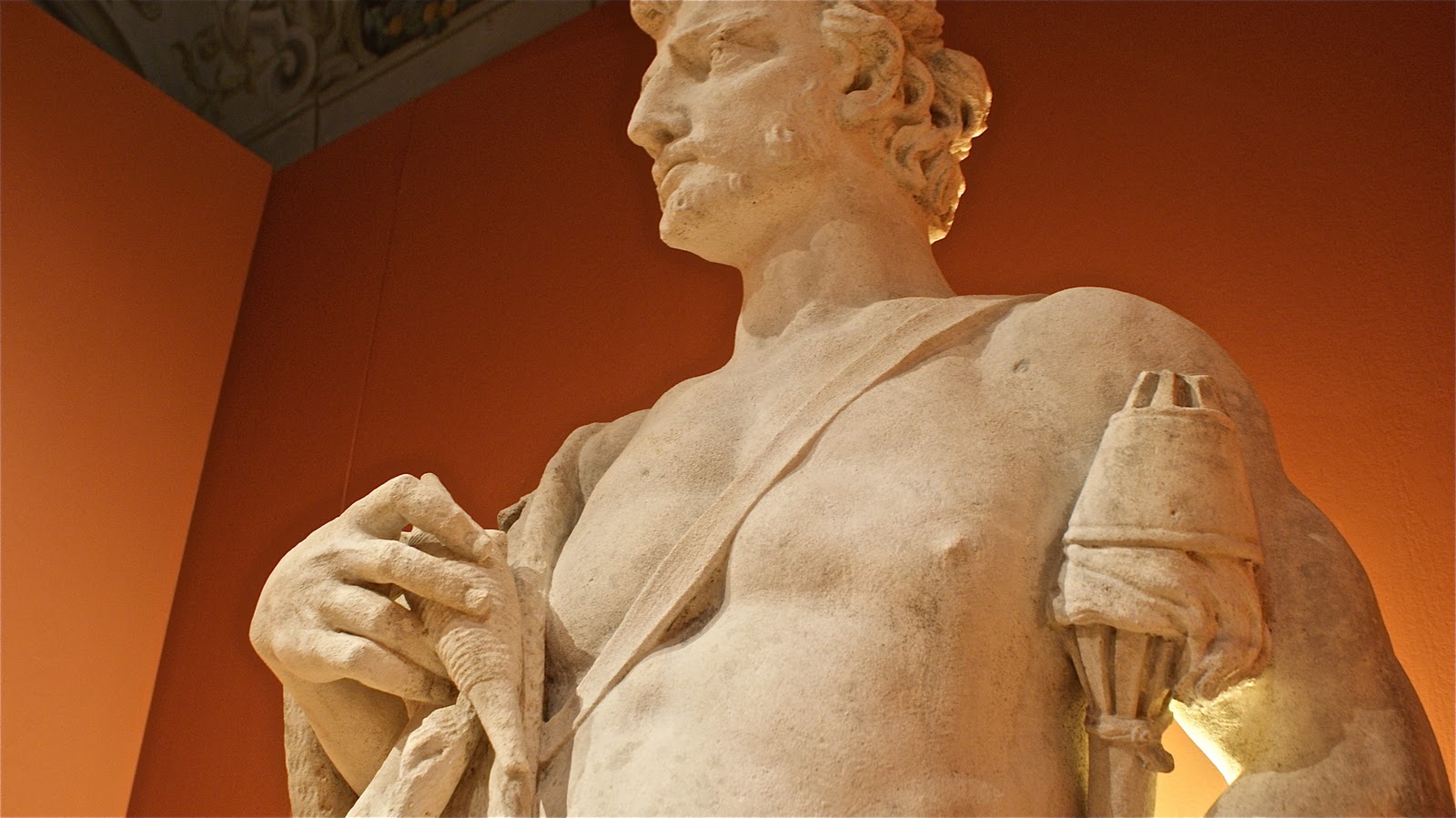
I don't know which stand we saw this work and who the sculptor happened to be, but if this hunk of a man happened to be alive, he would be date material. Oh, I think I found the reference in my Beautiful Florence journal--he must be the Lute Player (from where and when I don't know).

Next, we saw two dancing Moors, 18th century works from Germany. It is easy to imagine that the sculptures might have served as inspiration for Josephine Baker in her choice of costume for the Paris stage.


At the Sperone & Westwood (New York) stand, Carly especially liked this contemporary exhibit by Luigi Ontani (1997).


Nearby was a beautiful stand featuring antique jewelry. The exhibits were so attractive--see for yourself
-- that I forgot to take notes.


A sensation of awe came from turning the corner to come upon this statue fragment from 480 B.C. at the Turchi stand, exhibited by the only antique dealer in Italy specializing in archeological works.


If it weren't for prospective thieves and the price tag, it would look nice in the garden...

Actually, the only price tags we saw displayed were at stand # 39, Les Enluminures, which specializes in illuminated manuscripts. A single page started at 25,000 euro.


A fabulous gift would be these antique table and chairs on view at the Diana Vreeland stand.


But keeping in mind that we are heading towards Christmas, perhaps giving (or receiving) an authentic 18th century Neapolitan nativity scene would be more apropos.


Referring back to the previous post, "A County Fair in Florence," the mother has been found but now the child is missing. Where is Gesu Bambino (baby Jesus)?

Tuesday, September 20, 2011

A County Fair in Florence

      Florence, birthplace of Renaissance art, is probably the last place that one would imagine to find a country fair.  Never say never, however, as a county fair --called Ruralia--took place last weekend (Sept. 16-18) in the Cascine Park.

     The Cascine were originally cow pastures belonging to the Medici rulers before becoming transformed into a public park in the 1800s.  Not very well kept up and downright sketchy at night, Florence mayor Matteo Renzi has great plans to clean up the space and create an attractive public park complete with wi fi.  The first step to bring more people to the Cascine was the Ruralia event.

      On a very hot afternoon, photographer Carly and myself discovered that the 17C bus takes passengers directly into the Cascine Park.  Upon arrival, the bus driver hollered "last stop--Cascine Park!"


Carly and I got off in front of the Agricultural College of Florence University....


...to discover a multitude of county fair stands that stretched to the bottom of the park.  It was so hot that we visited just a few, and didn't manage to go down to all the way to the end to see the cattle and the hogs.


The first stand, predictably, showcased Tuscan wine, under the direction of the knowledgeable staff of Siena's Enoteca Italiana.  This Enoteca Toscana featured guided wine tastings (for a fee) every two hours.  


We were treated to a sparkling wine--spumante--made from Vernaccia 
grapes.  It was very special, and fabulous.


After 6 pm, the stand offered a happy hour for twentysomethings--2 drinks and munchies for 5 euro.  The happy hour entertainment consisted of two traffic cops--Graziano Graziani and Paola Troncone-- demonstrating a video on the hazardous effects of mixing drinking and driving.  


Following true Italian tradition, Graziani admitted that he cultivates grapes in his backyard in the nearby Florentine suburb of Scandicci, making table wine for family consumption.  He owned up to being the son of a Tuscan farmer (contadino).  He confessed, "my father named me Graziano Graziani because he would always say that once I learned my name, I would know how to spell my last name as well."

See what you can learn at a county fair in Florence.  Carly and I moved on to the next stand, which was about fish species native to Tuscany.


We were informed that the fish that you see above is a sturgeon, a storione, which until recently (due to pollution and man-made obstacles, like weirs) would swim upstream in the nearby Arno River to breed.  

Our next stop was a booth dedicated to wild mushrooms, both edible and poisonous, that can be found in Tuscan forests (by the way: Florence is located in the region of Tuscany).  We discovered that by law mushroom gatherers have to carry a wicker basket in order to allow the spores to fall on the ground.  The king of Tuscan mushrooms, of course, is the delicious fungo porcino.


Having been raised in the Hudson Valley, but not on a farm, I have no idea whether whether live music and ballroom dancing are normally featured at a county fair.  At Ruralia, Carly and I came upon Italian grandparents having a great time indulging in ballo liscio, not exactly a country reel.


Some of this group were more hip that we could have imagined
 (see below).


Our attention was drawn next to what was identified to us as a grain thresher....


A person in the know brought to our attention a sack of farro (spelt or emmer), an ancient grain brought to Tuscany by the Romans and still cultivated in the Garfagnana hills above Lucca.  It is the basis for many delicious soups and warm weather salads.


Moving on, we saw a display of olive trees.  A gentleman inside a nearby tent conducted on the spot olive oil tastings.  When we asked which was the best, he refused to commit himself.  


He did, however, give us a clue.  "Look for olive oil that comes from the hills of central Tuscany.  The closer the estate is to the sea, the milder (piĂ¹ dolce) the olive oil becomes."

So much to see!  We learned that there is sheep cheese made in the mountains above Pistoia from unpasteurized milk (latte crudo).  Carly took this picture of aged pecorino.


We met a very nice beekeeper from the Rufina hills above Pontassieve who insisted we taste his honey.


Although Carly and I never made it to the pigpen, we were given slices of salami made from cinta senese-- a small, gray Tuscan pig native to the Siena area characterized by a white stripe--close by to an explanatory chart.


The Cascine Park also hosts a ipprodromo, a Hippodrome, where occasionally polo matches are scheduled. Carly isn't sure whether these are random polo players visiting the country fair Ruralia, or whether the men on horseback are actually part of the park's security, keeping an eye on small children.

Dov'è la mamma?


Thursday, September 8, 2011

A Coffee Milkshake in a Traditional Café

 Well, I've just gotten back to the office after the nationwide August ferie (vacation), and it's still very hot in Florence even though it is September.  This morning for the time-honored Italian pausa caffè (coffee break), photographer Elke and I decided to try a place we'd never been.  Located behind the office, Vivoli is famous the world over for its homemade gelato.
 "Are you sure Vivoli serves coffee?"  I asked.  

"Natalia (a Vista intern) says she has breakfast here every day," replied Elke.  Once inside, for the very first time, I looked past the containers of signature Vivoli ice cream

 to discover an old-time traditional Italian cafĂ©.   Best of all, there were no waiters in smart jackets lurking around--I was ecstatic to find that I could order a coffee at the counter, bring it over, sit down and stay as long as I like and not be charged an exorbitant fee.  Have breakfast, meet with friends, do an interview, read the paper, daydream, write in my journal...all for the price of a coffee.  And also in the company of murals by Falai, a disciple of Annigoni.


I stepped up to the counter, and in view of the still-hot weather, 
asked for ice coffee. Long-time Vivoli employee, Tamara Galanti, 
suggested I try their caffè crema (it is an Italian idiosyncrasy
that each cafĂ© and restaurant lists a specialty that is found 
no where else).  Caffè crema?  It sounded appealing--so
I ordered it out of curiosity.  Tamara assured me that it was cool, 
coffee-ey and refreshing. I watched her place hot espresso coffee,
milk, ice cubes and a smidgen of sugar into a blender to create....
a coffee milk shake aka caffè crema.  No fake flavoring or additives.


VoilĂ !  Italians certainly also care about presentation.  Cool and smooth, it lived up to promise.


Meanwhile, Elke, who is German, didn't want to know about cold coffee for breakfast.  In her best Italian, she very confidently ordered a macchiato, accompanied by a budino di riso (a Florentine rice pudding pastry).
I shared some advice that an Italian friend, Daniele, gave me years ago.  "Always order espresso in a glass--it's tastes better (that I am tempted to give credence to) and is more hygienic,"  he told me (???).   Daniele (a soccer umpire in his free time) was so positive about what he said, that I became a believer, ordering my shot of Italian coffee in a glass every since. The Vivoli caffè macchiato came topped with steamed, frothy milk that the powers behind multinational coffee chains would sell their first-born to be able to imitate. 
But what caught my eye was the budino di riso, rice pudding pastry, which, at first glance, was unlike the out-of-the-same-mold boring version available in most Florentine coffee bars.

Silvana Vivoli, daughter and granddaughter of the original owners, stepped forward to explain,

"We make all the gelato and pastries served on the premises, and still use my grandmother's recipe for the budino di riso.  She used to put milk, butter and rice to heat over a low flame and would forget that it was cooking.  It would become soft that we could eat it with a spoon--which we still do.  Then, eggs and pastry cream are added, and the cooled rice custard is transferred to individual, homemade pastry shells."


Silvana is the one in viola shirt, the color of the local Fiorentina soccer team;  Tamara is next to her.
Silvana also revealed that her mother Simonetta originally lived across the way from Vivoli, which is located in the Santa Croce neighborhood.  One day Simonetta was locked out of her apartment, came to Vivoli to wait for her mother, and thus met her future husband, Piero, shortly thereafter becoming part of the Vivoli clan.
Simonetta is still found at the Vivoli cash register--"where else would I be?," she says.

Like everything authentic in Florence, every action--even having breakfast-- reveals a story
 embedded in layers of history.  And as always, something unexpected--like a coffee milkshake, christened caffè crema, in a Florentine cafĂ©.

Friday, August 12, 2011

Falling Stars, A Saint, Music, Free Pasta

     The second week of August in Italy is called Le Notti di San Lorenzo (aka the Night of the Falling Stars).  Italians flock to the hills, away from city lights, to see the shooting stars.  The expression is also the title of a famous Italian movie by the Taviani brothers, which I never managed to see.  The San Lorenzo alludes to St. Lawrence, whose feast day is on August 10.  Avid readers may remember the citation in Little Women, when Laurie referred to himself as "St. Lawrence on a gridion," for that was how the saint met martyrdom.           
      
  San Lorenzo was also the ruling Medici family's church during Renaissance Florence.  The facade, which remains unfinished (despite Mayor Renzi's recent proposal to finally implement the 1515 Michelangelo facade design upon finding sponsorship), resembles a humble cheese grater.  The church, a stone's throw away from the Cathedral (Duomo) is located in a characteristic Florentine neighborhood near the Central Market.  The latter, before the arrival of mass tourism, was where many residents (including myself) did their grocery shopping.
      
     The evening of August 10, 2011 in Florence was illuminated by a full moon which lit the annual festivities in honor of St. Lawrence.  I was inspired by this year's exceptional spring to christen this blog "Beautiful Florence," and the incredible weather, always sunny and rarely too hot, has continued into the summer.  So at 9 pm when people (including photographer Elke and myself) arrived in the square before the church to listen to the free concert, for once and probably for all time, no one was sweating thanks to a  boiling night characteristic of August in Florence.


We immediately saw St. Lawrence
on his gridion on a banner
above the church's main door.
When Elke and I showed up, 
a little before 9 pm, 
the very few people in the piazza
were sitting on nearby stone ledges 
jutting out from ancient buildings.


The Rossini Philharmonic Band started playing about 15 minutes late, and suddenly all the Italians arrived in a wave, filling the square.

 It was delightful to hear a band composed of wind. brass and percussion instruments in Italy--it reminded me of the many West Point band concerts I enjoyed lying on a blanket at Trophy Point above the Hudson Highlands and River.  The 150th anniversary of Italy's unification was obviously a theme, as musicians performed Verdi's Va Pensiero and the Oscar-winning soundtrack, The Song of Exodus.


A soft breeze ruffled the sheets of music, as the Rossini Philharmonic band moved on to Overture to a New Age, a selection of Beatle hits, Lord of the Dance, where a musician played the bagpipe part on a clarinet, ending with Ennio Morricone's spaghetti western soundtracks 
(Clint Eastwood would have certainly enjoyed this).
The last piece overlapped with traditional Florence music from the '30s and '40s performed the rest of the evening by a band one street over that decided to start on time.

Walking towards the food tables, we saw a vendor selling a souvenir of the evening.


Why Pinocchio?  I explained to Elke that Pinocchio's author, Carlo Lorenzini aka Carlo Collodi, was born in the San Lorenzo neighborhood before his family migrated elsewhere.


We talked to many local volunteers who explained to us that all the guide books write lasagna and watermelon are served free of charge to all comers courtesy the San Lorenzo Market Consortium, which was no longer true.  Gianpaolo Lazzeri, resident on nearby via Guelfa, said that local hygiene laws banned lasagna a few years ago, which is substituted by the Florentine dish penne strasciate--short pasta "dragged" in hot ragu (meat and tomato sauce) in a large frypan placed on a burner.


I recognized Sandro Savorelli holding the frypan.  He owns a traditional civaio shop, which sells beans and rice from large burlap sacks as well as spices and practical household goods in addition to items like beach umbrellas, on via Taddea.

"Hey, I didn't know you were a cook," I said.  "I didn't know you were a journalist," he commented.  His pasta was authentic and delicious, accompanied by a plastic cup of red wine.  The local milk consortium, Mukki Latte, donated cartons of yogurt "as dessert," in addition to the traditional watermelon.


I explained to Elke that when I arrived in Florence during the '80s, in the era of no air conditioning, during the hot summer months, cocomerai (watermelon vendors) were stationed at stands open most of the night on the boulevards (viali) encircling downtown Florence.  Elke complained that the watermelon attracted mosquitoes, to which I replied that only she, along with American girls on their way to bars would dare walk around summertime Florence in short skirts and bare legs at night, especially during Le Notti di San Lorenzo.

Tuesday, August 9, 2011

Poolside Cocktail Hour

When the temperature is searing in downtown Florence, what better way to relax than with aperitivo? 
Beautiful, delicious pre-dinner snacks washed down with bubbling, chilled cocktails at the hour of sunset seem to be quite a worthy way of paying tribute to the sanctity of food.


Understated, contemporary opulence provides the background for a poolside aperitivo at Villa Cora, located between Porta Romana and piazzale Michelangelo, also open to non-hotel guests (reservations recommended).


Hedges fronted by elegant statues
 on one side and tall evergreens on another 
edge the pool.  The pavement 
is cream-colored marble 
with a glimmer of rose, and guests sit
 on brown wicker armchairs with 
white cushions.


Barman Luigi prepared two specialties:  
an Aurora (fresh squeezed orange juice, peach juice
and spumante) and a non-alcoholic Pear Moijito, 
garnished with mint.  


The drinks arrived with individual portions of Parma ham and cantaloupe, little sandwiches, a fried zucchini blossom delicately stuffed with mozzarella and anchovies, and raw vegetable sticks to scoop up guacamole or blue cheese dip.


A buffet of the same food is set up near the bar for a second helping.  The overall brown and cream color scheme is repeated in the smart attire of the waiter who brings drinks and finger food. 


On Thursday, the music of American, Italian and French rock, pop recordings as well as jazz classics fills the air.  Aperitivo at Villa Cora is served from 7 to 9:30 pm, Thursday evenings with music at 15 euro, 10 – 18 euro other evenings, depending on the drink ordered.

As dusk falls, the pool’s turquoise water slowly turns jade thanks to the illumination under the surface. 
Una bella serata.