Wednesday, May 22, 2013

The 2013 Florence Gelato Festival Saga

A gelato festival is clearly for kids of all ages.  The 2013 edition of the Florence Gelato Festival, however, ruffled the feathers of more serious grown-ups.
As announced by this events poster (below), published by the Florence's town hall (Palazzo Vecchio),
the fourth annual Gelato Festival, hosted in three central squares--Piazza Santa Maria Novella,
Piazza Repubblica and Piazza Strozzi--was scheduled to take place for an unprecedented 10 days instead of the usual four days.

The news of the Festival is visible on the left on the official events calendar compiled and
published by the city of Florence--forgive the reflection of the glass case.
The dates--May 17 - 26--are, however, clearly visible.

Well, only several days before the opening, Florence's city council announced that the Gelato Festival could only be held for the first four days, and the remainder CANCELED.  The reason given was that, according to tradition, a commercial event involving the sale of products normally occupies
Florence's historic squares over a long weekend.
Why no one thought of this before is a mystery....

As I had posted a long article on the Gelato Festival on our new website (www.magentaflorence.com),
which would be re-posted in our English column on Florence's Repubblica newspaper site
(www.firenze.repubblica.it), I gave the organizers a call.
"The festival will close at midnight on Sunday, May 19," I was told.
Of course, I hurriedly substituted the article, and like most Americans, believed what I was told.

But, this is Italy, of course.  On Monday evening I walked through one of the event venues and found the stands still up (below).
"What's going on?" I asked, and was handed a free cup of creamy Italian gelato.
"We were ordered to close down.  But since we can't take the ice cream,
 all of it is being given away," replied the vendor.
While witnessing one visitor inelegantly scrambling to find a container to walk away with as much ice cream booty as possible, I enjoyed my dinner antipasto and opted to go home.  After all, I had stumbled upon a complimentary treat to mark the festival's end--or so I thought.
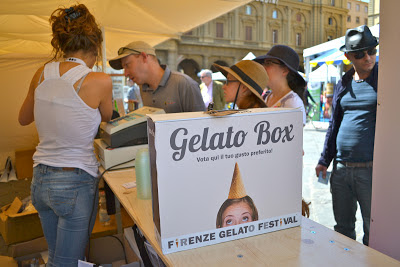
On Tuesday, in piazza Repubblica, I found people once again lined up at the admission booth (above).
What is going on? -- I thought.  I stepped up and was told thanks to a court order issued that day at
11 am, the Gelato Festival would continue through its originally-announced end date, that is,
until midnight, May 26.

But there was only one problem...
all the gelato had been handed out to unsuspecting passersby the night before!
The woman at the cash desk assured me that more gelato would arrive by that evening.

Later on, in the office, intern Annalise Kapusta was trying to update the Puccini summer opera festival write-up.  She noticed, however, on the official 2013 program, that the actual dates did not correspond to the days of the week listed (!).  I quickly moved to a computer and found an online ticket sales site.
"Look at their calendar, it must be correct," I said.

Of  course it was.  At least this time I was operating according to the Italian time-honored tradition of the arte di arrangarsi -- the art of getting by.

The entire country runs according to this unwritten law,
 stronger than those actually on the books.

 I complained about the wrong dates being on opera site, and an Italian friend, Mario, commented
"Don't be so German."

German, indeed!  As a full-blooded Italian-American, my American side was miffed by the incorrect information, but my Italian side found a way to get around the problem.

So did the Gelato Festival organizers--thanks to filing a court complaint,
with city council overruled
and supplies rushed in,
ice cream, Italian style, is now being served.


Thursday, April 25, 2013

Comfort Food: Neapolitan Pizza in Florence

Today is a legal holiday, marking the liberation of Italy from Nazi occupation and the end of the Fascist regime, thanks the combined efforts of the Allied armies and Italian Resistance partisan fighters.
As reported by Beautiful Florence's previous post, a violent act of private war had caused deaths at the Boston Marathon just as I was about to write on a Da Vinci restoration.  The city holds many memories for me.  As I write, in the office I can turn my head to view my framed master's degree from Boston University.  I was unprepared, however, to see the following e-mail message on my I phone.
Emilia Gambardella, one of the interns at our English-language publishing house (www.magentaflorence.com), arrived in the office similarly upset.  Her sister is a student at Boston's Northeastern University.  "The city is in a lockdown, it's difficult to get news," she said.
"Well, look at this on my phone," I replied.  "A grad student at BU was one of the three victims in the marathon bombing."

"Well, the suspects killed a cop on the MIT campus and the police are searching everywhere in Watertown," she informed me.  This is getting worse and worse, I thought.  MIT is between Kendall and Central squares, the latter close to Harvard Square, Cambridge, where my last home was located before moving to Florence.  I wrote that I had also lived in the Fresh Pond neighborhood in Cambridge.  In actual fact, Fresh Pond was behind my apartment, which was situated off of Mt. Auburn St. on a little road just before the Watertown-Belmont line.  Watertown, that most anonymous of Boston suburbs, and rightly so, 
 had just lost its anonymity to participate in a tragedy.

Emilia was in the office to discuss researching her upcoming article on Neapolitan pizza in Florence for Vista, Florence & Tuscany.  As her father, a former waiter-turned-Wall Street-stockbroker, was born in Naples, it was an obvious choice.  On this occasion, I told Emilia that the day after 9/11, another writer in my office, Stella Fiore (also a BU alumna), and I sought refuge in the good, genuine food made by Carmine, Florence's original Neapolitan pizzaiuolo
(pizza chef).  Later, in 2008, a group of friends took me to lunch right after my mother's death at Carmine's new trattoria, Vico del Carmine.
When my friends asked for the check, Carmine informed them that the meal was on the house.

Let's go and see if Osteria del Caffè Italiano still has a Neapolitan pizza annex," (left) I said, "and set up when to go back for a meal and interview.  It is but five minutes from the office on via Isola delle Stinche."
We walked in and found pizza chef Vincenzo on the job.  "You're lucky," he said, "the owner is right outside."
Osteria del Caffè Italiano's proprietor, Umberto Montana, came to embrace me despite the fact that I had not seen him since 2006, when working on another story.  He called for spumante (Italian sparkling wine) for Emilia and myself.  He apologized for having to dine with a theatre troupe who were to go on stage at that evening at the nearby Teatro Verdi, and asked the pizzaiuolo to prepare a pizza for us to share as aperitivo
(pre-dinner drinks and snack).
Goodness, these are all the faces of my possible ancestors and paesani, I thought when looking at the placemat.  After all, Umberto Montana hails originally from the region natives know as Lucania
(re-christened Basilicata by fascist leader Mussolini, who came to a bad end as remembered at the beginning of this article).  Umberto is from the province of Potenza in Lucania, both my late parents from the 
province of Matera.
Meanwhile, our pizza was baking in an authentic wood-burning brick oven.
As he was shredding mozzarella cheese with his hands, Vincenzo informed us all the ingredients came from the south, or more precisely, vengono da giù.

Chi non la conosce, non capisce, chi l'assaggia, la comprende said Vincenzo.
"Who is unfamiliar with [Neapolitan pizza] doesn't understand, who tastes it will comprehend."
Below Emilia (left) and your distraught Beautiful Florence blogger are about to receive,
as unseen tradition would hold, the ultimate comfort food, Neapolitan pizza.
Again, unbelievably, on the house.
Pizza è come la donna, è amore, said Vincenzo
(Pizza is like a woman, it is love).
He  told us he hails from downtown Naples, the Sanità neighborhood. With music by the Neapolitan 
Pino Daniele playing softly in the background, we began to relax.
Emilia and I were treated to an authentic Margherita, comprising tomato, cheese & basil.
The crust was thin, crispy and chewy, the flavors flavorful and as the ultimate critic, Emilia, observed, 
subtle and perfectly balanced.  

Much more relaxed, but still on the job, I addressed the following remark to Vincenzo,
who happened also to be suffering from a bad cold.
"The important thing," I said, and was about to say
that the expert Emilia tasted the pizza, when he finished my sentence...
.

"is to be well."  (è stare bene)

There was nothing more to say, but to be well again.

All pictures in this post, except for the very last, were taken by faithful Beautiful Florence blog photographer 
Bree Chun.  Emilia recorded this image of Vincenzo at work.

In the meantime, the BU alumni association has sent me another e-mail.  It has already raised over 700,000 dollars in memory of the graduate student who lost her life watching the Boston Marathon.  
And life with all its surprises continues from my vantage point in 
Beautiful Florence.


Tuesday, April 16, 2013

Spring, Heartbreak & Da Vinci

Sun and warmth finally arrived in Florence & Tuscany this past Sunday, April 14.
Yesterday I caught librarian Joanna June in the act of taking a picture of our now blossoming wisteria vine (see previous post) in the Borgo Albizi courtyard.  Joanna, who has kindly allowed Beautiful Florence to publish her photo, works at the Florence campus of Florida State University, which is located in the same building as our office.
All sweetness and light after a long, chilly and record-breaking
 wet and never-ending winter it would seem.
It was... until an event turned the blood in my veins into ice.
"Bombs on the Marathon," screamed the Repubblica headline.
Oh, my God, the Boston marathon.

If I turn my head, I can see my framed masters degree from Boston University, where I commuted from 
where I was living in Cambridge, initially Fresh Pond, then behind Harvard Yard.
The marathon finish line is on Boylston St. close to Copley
and the venue of my first job, on Park Street.

Participants tackled Heartbreak Hill near the end, only to run down to face real heartbreak.
Boston and Florence are living examples of the world's intellectual capacities and freedom, accompanied by a good dose of heart.

Besides showing that spring has finally sprung in Florence, I meant to write about the 
current restoration of a 1480 Leonardo da Vinci work.  This report is timed to coincide with the airing of an historical fantasy,"Da Vinci Demons," based on the early life of the Renaissance genius
 later this month on the Fox channel.
According to Dr. Maurizio Seracini, Leonardo completed the underdrawing for the Adoration of the Magi which did not win the favor of the commissioning San Donato a Scopeto monastery.  Da Vinci departed for Milan, other artists added color, glue and retouches on top before the oil on panel disappeared into the monastery storeroom.  Resurrected by the Uffizi Gallery in 1670, the Adoration of the Magi remained on public view before disappearing again into the hands of restorers at the Fortezza da Basso laboratory of the Opificio delle Pietre Dure.
Out of view, that is, except to professional journalists, including your faithful Beautiful Florence blogger, who were called in to hear restorers pronounce the diagnosis above.  They also mentioned that the wooden support was not in great shape either, causing pigment to detach.
The restoration was announced to be conservative, that is, a cleaning plus strengthening the support.
When the monochrome masterpiece returns to the Uffizi, visitors will be able to better admire such details as the magnificent horse's head clearly drawn by no other than Leonardo da Vinci.
Part of the reason possibly why the nascent work failed to find favor 
is that behind the serene Virgin Mary and Child is a battle scene!
Leonardo da Vinci is remembered for his unique brand of three-dimensional realism, given depth by a play of chiaroscuro (light and shadow).   In the Adoration of the Magi (photos courtesy of the Fine Arts Ministry, Florence), didn't da Vinci simply give a sublime summary of the human condition?
In the foreground, the Three Kings, form a triangular composition around the Virgin Mary and Child they are adoring.  After all, this is their reward for listening to their hearts and following a star
to the ultimate Redeemer.

The rest is just strife, conflict and bloodshed...just like that found at the bottom of Boston's
 Heartbreak Hill.

Over six centuries later, Leonardo da Vinci's encapsulation of the life's peace and drama 
remain contemporary and timeless.
No need for color, the painting as it appears can be considered finished--there is no more to say...

     Reporting live from Beautiful Florence
                                -- Rosanna

Tuesday, April 9, 2013

Spring 2013 in Florence

Into each life, some rain must fall.
Agreed, but thanks to the precipitation of this past winter and early spring, 2013 has been the year with the most rainfall in Florence for the past 50 years.  In my just-previous Easter blog, I predicted it might stop raining on the day of the Resurrection.
 It actually did--and on the following day, Easter Monday, as well.
Then it started again.  Above is the scene in our Borgo Albizi courtyard from the office window.
Thanks to gray, overcast skies, the wisteria has only produced a few, timid blossoms,
 and the fig tree it is wrapped around, just one leaf!

Faithful Beautiful Florence blog photographer Bree Chun and I decided to take a stroll around downtown Florence in search of some color, and warmth.
We found it on the new pedestrian-only zone comprising the sidewalk and road in front of the
designer shops on via Tornabuoni.
The medieval palace in the background is no other than the Ferragamo flagship store.
Via Tornabuoni also hosts the pricey boutiques of Prada, Armani, Gucci and Tods, just to name a few.

If this is how these shops are using the mark-ups on their astronomically prized clothes,
I applaud their efforts.  The rose pink and magenta colors stand out against a backdrop of silver gray light and matching sidewalks.

Walking back to Borgo degli Albizi, Bree and I turned into via Porta Rossa,
where a surprise awaited us--an imaginative, cheerful window display.
No, it was not the usual show of shoes, handbags and pastel spring clothes...
...it was a celebration of the new Pope!  Papa Nuovo in Italian, and popping out of an Easter egg to greet and bless the world.  Mind you, this is Florence, not Rome and the shop in question sells objects in silver.  The eggs in the silver holders--creative advertising--below the papal poster are inscribed with the member names of the college of cardinals who were in the running for the top job.


 Papanuovo is also a clever play on words since
  ovo means egg in Italian.
Easter eggs are traditional fertility symbols, so one can only hope that...
April showers will bring May flowers.


As a contrast to the scene outside our window, here is a May preview--provided by a vase of freesias on the office table.
Maybe spring is merely a state of mind.

Reporting live from Beautiful Florence
    -- Rosanna

Friday, March 29, 2013

Easter 2013 in Florence


Right at the end of the Uffizi line, through a doorway between the statues of Lorenzo the Magnificent and his father Cosimo the Elder de' Medici, is an Easter gift
 to residents and visitors to Florence alike.
Past the entrance and a room with 20th sculptures by Marino Marini and Venturini
is the crypt of the former church of San Pier Scheraggio and a display of three medieval crucifix panels
(open 9 am - 8 pm, free admission!) for the Easter holidays.
The most expressive one, in the center of the crypt, is the above 13th century Crucifix from Pisa.  With resplendent gold work framing a tranquil, wide-eyed Christ and Stories from the His Passion--including the Betrayal and the Deposition--the tempera on panel work displays a variety of influences.  Since Pisa was a seaport at that time, the town absorbed the visual languages of Mediterranean lands as varied as Syria and Palestine to Sicily, famed for its mosaics of Arab inspiration.

While this tranquil Christ, with wavy hair coiling on his shoulders, seems to have transcended his suffering,
this cannot be said for the another Crucifix panel displayed in the same room.
Head bowed, eyes closed and hands oozing blood, this Christ was also created in the first half
of the 13th century in and around Lucca, not far from Pisa.  The scenes from the Passion surrounding the figure  depict Christ in various mournful scenes, from the Judgement before Pilate, to carrying the cross, to the Deposition, the Entombment and finally and an angel standing between an empty tomb and the
three Marys
who seek Christ on Easter morning.

This Crucifix is attributed to the so-called "Master of the Cross," who in turn was to inspire Coppo di Marcovaldo, the artistic precursor to Cimabue and Giotto, who was to introduce the
revolutionary Renaissance style.
Recently restored thanks to funding by the Amici degli Uffizi (Friends of the Uffizi),
the works displayed in San Pier Scheraggio will be moved to Room 2 of the Uffizi,
in the company of the the two above-mentioned crucifix panels and another by Duccio.
Christ is KO in the third exhibit, a diptyph (a smaller, two panel piece); in fact Mary in the scene below His armpit has fainted.  Again created in Lucca early 13th century, Christ's elongated body seems to 
presage the distinctive figures in the paintings of the Renaissance artists El Greco.

Looking at this work, it is clearly Good Friday in Passion Week, which today actually is.
With rain non-stop since Christmas, no government formed as a result of the February elections and problems stemming from a deep recession, Italy can be said to be currently experiencing its own
Via Crucis,
Stations of the Cross before the Crucifixion.
But guess what?  Easter is around the corner--that means Resurrection and a new start.
Maybe it is no coincidence that the other part of the diptych panel portrays
 Mary and a newborn Christ.


There is even an angel in a pink rose robe holding a globe with feet firmly on a dragon devil.
Evil will be overcome, life goes on.

Maybe it will even stop raining.

Buona Pasqua 
from Beautiful Florence

Tuesday, March 19, 2013

Rufina: Finding Old Acquaintances in a Tuscan Villa

This past weekend, Beautiful Florence blog photographer Emilia Gambardella and myself
were invited guests at an event hosted at Villa il Petroio.  Upon arrival, after going up the Tuscan hills near Florence between Rufina and Pontassieve, I recognized host Eduardo Robiglio (left). whom
I had interviewed in Florence seven years ago.  He introduced me to his mother, Carole Bolton (right).
I discovered that Carole and I had studied, in different years, at Florence's Università per Stranieri
(University for Foreigners).  She told me that right before she was to leave, she met her future husband,
Eduardo's father.

Why did I talk to Eduardo in 2006?   I am best known as an art writer, if not art,
then food.
The dessert that was served to the guests at lunch, chocolate truffles, gives the idea of the subject of
our talk, which was hot chocolate.  I reported that the premium Italian hot chocolate served at the Robiglio café on via de' Servi "represents a family tradition spanning 75 years."
Just a year later Eduardo sold the business and they started a new chapter in life.

The Robiglio had renovation work done on their weekend home in the Tuscan countryside.
This is the view from Villa Petroio on a variable March day.
The Robiglio family now rents the villa, guest wing and medieval village to host weddings or family reunions as well as producing estate-bottled olive oil and wine.
Speaking of wine, above are bottles of Villa Petroio wine, a blend of Tuscan Sangiovese and Canaiolo grapes with Merlot, on the lunch table.  As you can see, the floral arrangements matched the furniture.

Ever curious, I wandered into the kitchen for another surprise.

One of the cooks was a family friend just giving a hand.
"I've known Eduardo since he was a child," said Anna Bini (above).

The surprises continued.  Holding up eight fingers to represents decades, she confided her age.
Initially working in fashion in Florence, she moved to Paris to open a restaurant in order to legally employ her three sons.  "With a work contract abroad, this meant they were exempt from the draft,"
she told me.  "And one of my sons liked Paris so much that he is still there today
to manage the Casa Bini restaurant," she added.

Anna's proud demeanor was a mix between Parisian and Tuscan.
Pointing to the risotto with Tuscan porcini mushrooms that she had prepared,
Anna said in a whisper, "the rice is parboiled."

It was delicious.  I explained to Anna that parboiled rice is common in the U.S., which was
after all Carole Robiglio's homeland.

The hospitality continued with a concert of Florentine folk songs.

The group sang traditional stornelli which they heard as children.
The instruments ranged from the accordion, guitar and tamborine to
(surprise again), a saxophone.

The group's name is Gli Amici del Chianti, but talking to them I discovered the musicians hailed from the nearby Valdarno area, only part of which could be loosely defined as "Chianti."
Maybe the fact that Disney has also hired them to entertain Americans on tour in Tuscany
inspired their name.

The accordion player, named Simone, told me that he comes from
a village of 100 residents named
Bombone.

"But I have been there!" I exclaimed.  "During my first summer here during the '80s, I was hosted by a family in a remote area called 'Marnia' in the woods near Rignano.  One hot August evening, we drove over to Bombone, as we found out, the place were artist Ardengo Soffici was born, to attend
a donut festival.  Townswomen wearing comfy slippers were frying and serving
donuts (bombolone) on the streets of Bombone at midnight.
As usual, I was the only American in sight.

Simone was dumbfounded, and highly amused.

"Bombone is near Rignano sull'Arno, the home of Florence's mayor
Matteo Renzi," he said.

"And did you know him?" I asked.
"Of course, I remember him as a child walking down the street with the newspaper under his arm,
a sure sign of his future calling," he replied.

"And now?"
"Well, I voted for him...and he disappeared, a true politician," he told me.

"Let's drink to that," said everyone else within earshot.

Reporting live from Villa il Petroio
for Beautiful Florence.
                                              --- Rosanna

Monday, March 11, 2013

Italian Elections in Florence, Part 2


Who are all these cameramen and journalists crowding around in Piazza Signoria?
As recorded by faithful Beautiful Florence blog photographer Bree Chun, 
the sought-after gentleman found just behind the tripod is
no other than Florence's mayor, Matteo Renzi.
Renzi is just trying to report for a day's work in Palazzo Vecchio (city hall).

The excitement stems from the fact that although Renzi lost the Democratic primary for prime minister,
the candidate, Pierluigi Bersani, did not win enough votes to form a government.
There may be a new election, and before that, a new Democratic primary.
Renzi is aiming to win the eventual rematch with Bersani and become Prime Minister.
Here we are back during the February mock election in which both Italian and American university students participated at the Florence campus of Pepperdine University.
 Professor Alessandro Chiaramonte is explaining possible post-election alliances.
Perhaps he did not take into account that the Movimento Cinque Stelle founded by Beppe Grillo
 could win an unexpected 25% of the vote, and refuse to ally with any existing political party.

What is especially interesting is that the vote tallied at Pepperdine (see previous post, Italian Elections, the American and Italian 'Vote') corresponded to the write-in vote of Italian living overseas--with the coalizione di sinistra (the center-left alliance including Bersani's Democratic Party and Vendola's Left, Ecology and Liberty movements) winning a clear majority, and the rest of the parties (the center coalition headed by outgoing Prime Minister Mario Monti, the right wing coalition run by Silvio Berlusconi ) winning a nearly equal number of votes.
The exception overseas was the Movimento Cinque Stelle, which finished last, not third as back home in Italy.  There are fewer angry Italian residents abroad who wished to cast
 a protest vote, it would seem.
The result at Pepperdine was also remarkably similar to the actual election results in the city of Florence.   The voters here are strongly left of center.

Where does Italy go from here?  Good question.
Media reporting to the contrary,
life goes on.

After the political conference and mock election at Pepperdine,
the Italian and American students and faculty adjourned to the nearby countryside,
where they prepared homemade pizzas, which were placed into a outdoor brick oven to bake.

Besides wondering what will happen politically--whether Italians will return to the polls or if another interim government composed of technocrats will be formed--preparing food and sharing a meal is still big on the country's agenda.  Here it also provided a chance for Pepperdine students to become acquainted with and make friends with fellow students from their host country.

And what do Italians, as well as these students, occasionally do after lunch?
Play bocce of course, especially on the weekend.